
TL;DR:
After leading the tokenization of a corporate design system, I wanted to answer an uncomfortable question: "how much of that can I do myself, from scratch and alone?". Coloma Design System is my answer. A monorepo with two deliverables: a design tokens package in the W3C DTCG standard format — with a two-layer architecture, primitives and semantics, connected through aliases — published on NPM under an MIT license, and a web viewer that flattens the nested JSON, resolves the aliases, and documents every token using Web Components with Shadow DOM. All of the JSON is written by hand: I deliberately avoided exporting from Figma so I would internalize the alias mechanism, the core concept behind a semantic layer. It's my technical proving ground and, being open source, the only design system work of mine I can show in full.
Why this project exists
All of my design system work lives inside a company, under confidentiality agreements. That creates two problems: I can’t show the code or the components, and — more uncomfortably — it’s hard to prove how much of the system is my own method and how much is context.
Coloma Design System exists to close that gap. It’s 100% mine, open, and demonstrable: every architectural decision, every token, and every line of code is public and auditable.
The question I asked myself: take away the team, the budget, and a corporation’s infrastructure — can I still build a proper design system from scratch?
The architectural decisions
DTCG (W3C) format from the very first token. I chose the Design Tokens Community Group standard over a proprietary format. It’s the specification the industry is converging on, and the one tools like Style Dictionary consume natively. Designing against the standard — not against a tool — is what makes a system portable.
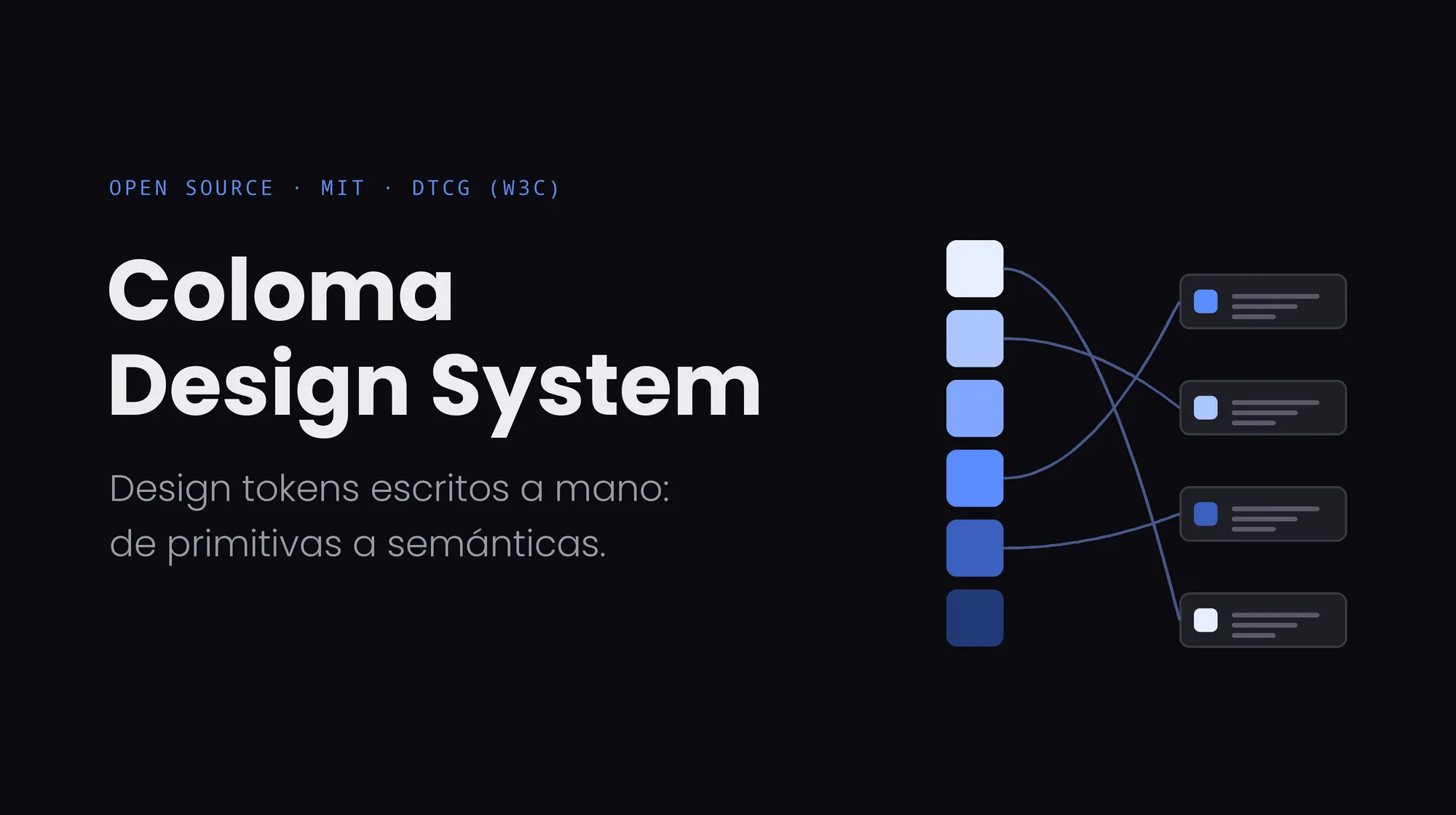
Two layers: primitives → semantics. Primitives hold the raw values: eight color families in OKLCH (with hex fallbacks), spacing, typography — sizes, weights, line height and tracking — radii, shadows and z-index. Semantics contain no literal values: they only reference primitives through aliases. The rule I set for myself is simple and brutal: if I write a hex value in the semantic layer, it means a primitive is missing. That discipline is what lets a rebrand cascade through the system instead of becoming a find-and-replace.
Monorepo with npm workspaces. One publishable package (tokens) and one deployable app (token-viewer), without adding build tooling that obscures the concept. I wanted to understand hoisting and dependency resolution, not configure them blindly.
Web Components with Shadow DOM for the viewer. I could have built it in a framework, but I chose Custom Elements with Shadow DOM precisely because style isolation is what makes a system component work in any stack. That’s the right mindset for a design system: framework-agnostic by design, not by accident.
MIT license. Unlike my portfolio, this project is built for adoption. If someone wants to take it, fork it, or learn from it, that’s the point.
The most counterintuitive decision: writing the JSON by hand
I could have exported the tokens from Figma with a plugin in an afternoon. I chose not to, for two reasons:
- Most exporters resolve aliases into literal values. That destroys exactly the semantic layer that gives the system meaning: you’re left with a flat JSON full of hex codes and no intent.
- Manual transcription isn’t wasted work; it’s where the mechanism sinks in. Understanding why
surface.feedback.successpoints togreen.100and notgreen.500— an alert background needs the lightest step so the text on top keeps its contrast — isn’t something you learn by reading an export.
Automated Figma → repository syncing is a real problem and I’ll tackle it as its own project. But first I wanted to master the format, not the tool.
The viewer’s technical challenges
Flattening variable depth. The viewer consumes the nested JSON files and needs to turn them into a flat list. Depth isn’t fixed: spacing.8 is two levels, color.primary.500 is three and color.surface.overlay.state-layer.hover is five, so iterating with map() isn’t enough. The solution is to walk the object recursively and tell a final token from an intermediate group. The standard itself gives the hint: a final token is the one declaring $value; everything else is a group you keep descending into, accumulating the path and inheriting whatever $type the group declares.
Resolving aliases. A semantic token only says {color.green.100}. To show the actual color, the viewer looks each reference up in the already-flattened primitives list and swaps in its value and type. If a reference doesn’t resolve, the token is shown as-is: the error stays visible instead of hiding.
Grouping without multiplying components. The 155 tokens are grouped by category with a reduce that reads the relevant level of the path: the first for primitives, the second for semantics, since they all start with color. A single Custom Element, <token-swatch>, decides how to preview each token from its type: a color paints a swatch, a spacing value draws a square to scale, a shadow casts it, a font size renders text.
Copy to clipboard, and finally understanding async. navigator.clipboard.writeText() returns a promise, so the click has to wait for the browser’s confirmation before showing “Copied!”. That forced me to answer three questions I’d been using without fully understanding: why the function must be async, what exactly happens during the await, and why a try/catch is the only way to tell the user when permission fails. One UX detail came from testing it: two quick clicks made the first feedback’s timer wipe out the second; the fix is cancelling the previous timer before scheduling the new one.
System decisions you can’t see in the JSON
- Seven steps, not nine. Every color family has seven tones. Fewer variants means less maintenance and fewer unused tokens; if an eighth is ever needed, it gets justified when the case shows up.
- Different scales for different problems. Spacing is stepped: increments of 4 up to 16 px, where the eye can tell fine differences apart, then increments of 8 up to 64. Typography is modular, ratio 1.333, with values rounded to 1/16 rem so they land on whole pixels.
- Alpha without an alpha function. DTCG has no way to say “this color at 10%”. Rather than sneaking literal values into the semantic layer, I added two primitive families,
dark_alphaandlight_alpha, with seven opacity steps of pure black and pure white. They feed modal backdrops and state layers. - One interaction model. No action token has its own
hoverorpressed. States come from overlayingsurface.overlay.state-layer.hoveror.pressedon the base color, Material’s state layer pattern. One mechanism for the whole system instead of three tokens per variant per role. - OKLCH with a safety net. Colors are defined in OKLCH, with the hue nudged a few degrees toward each scale’s extremes to compensate for perceptual shift, and every one carries a
hexfallback for tools that don’t read it yet.
Current status: v0.1.0 published
The first project’s scope is closed and merged into main:
- ✅ Monorepo with npm workspaces.
- ✅ 155 tokens in valid DTCG: 111 primitives and 44 semantics, all aliased, none with a literal value.
- ✅ Viewer: recursive flattening, alias resolution, gallery grouped by category and copy-to-clipboard with feedback.
- ✅ READMEs for the monorepo and the package.
- ✅
@coloma-design/tokensv0.1.0 published on NPM under the MIT license. - ⏳ Public deployment of the viewer.
What’s next. It’s a living project. On the backlog: WCAG contrast validation inside the viewer, the third token layer (component) alongside the first components, and a Style Dictionary pipeline transforming to CSS and JS, which opens the door to theming and to syncing from Figma with judgment.
What it’s teaching me
Building a small system alone forces you to justify decisions that in a corporation get made by inertia or inheritance: why seven color steps and not nine, why spacing is stepped while typography follows a ratio, what criteria define the neutrals. Constraint is the best systems teacher.
And there’s an unexpected benefit: every concept I land here — recursion, style isolation, async, semantic versioning, publishing — makes me a better partner to the development teams at work. The gap between design and engineering closes by building, not by explaining.