
TL;DR:
MAYA is the system hundreds of thousands of Yanbal salespeople use to run their business every day across Latin America. The previous version worked as an order-taking tool — it completed the transaction, but didn't support the user's business, and adoption had stalled (80% among Directors, 25-32% among Consultants). I led the end-to-end UX/UI redesign, coordinating research, strategy, and design with 90+ stakeholders and each country's development teams. After 150+ interviews, 145+ concepts, and a pilot with 200 Junior Directors in Ecuador, we turned MAYA into a business intelligence platform focused on action, not just data. The result: adoption rose to 95% among Directors and 39% among Consultants, with a rollout now underway across 50% of Yanbal countries. The biggest unlock was strategic — discovering that fear of the digital channel was designed, not innate.
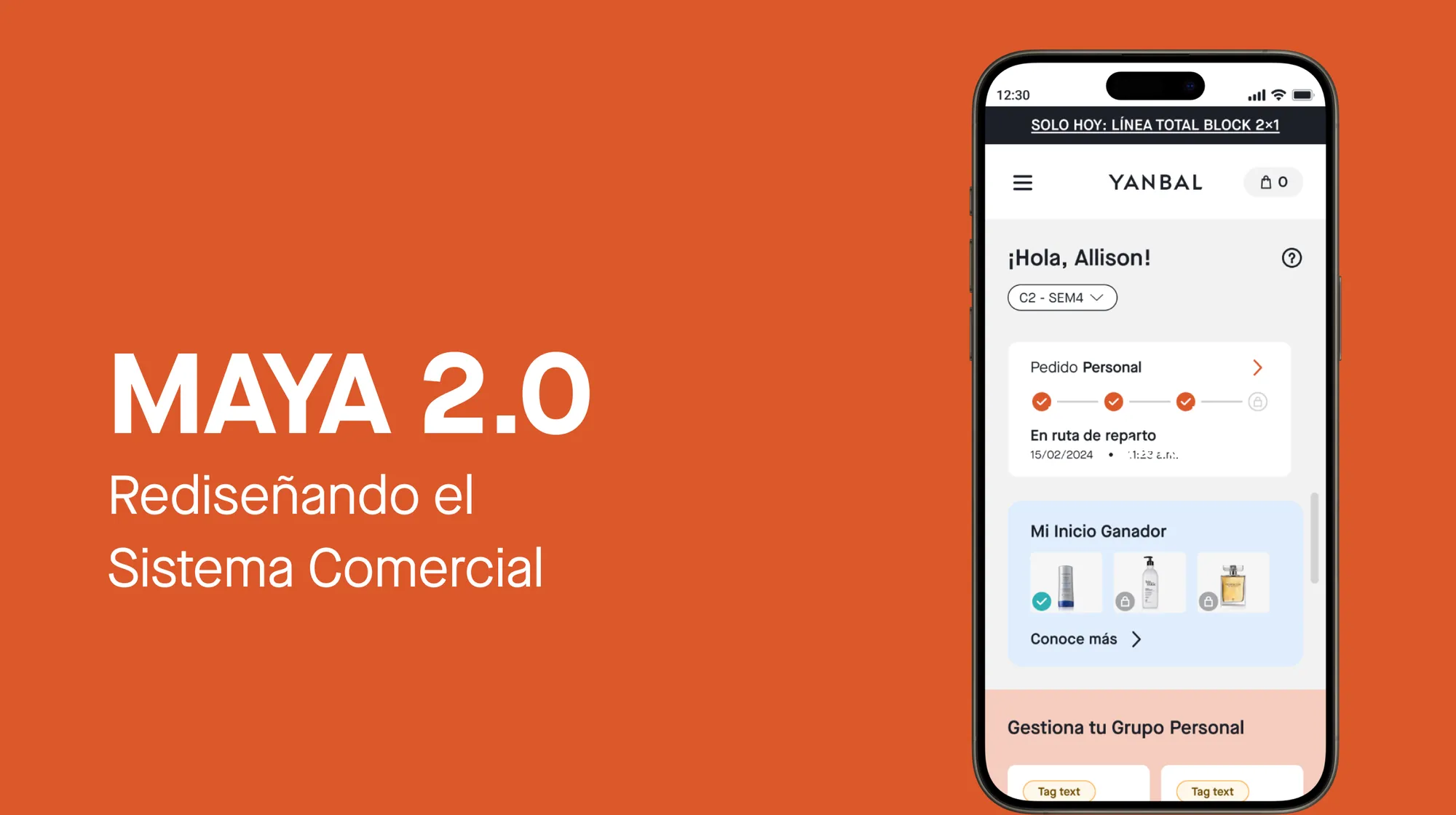
The Business Challenge
MAYA is the tool hundreds of thousands of salespeople use to run their business across Peru, Colombia, Mexico, Ecuador, and other markets. The previous version took orders but didn’t support the user’s business: adoption had stalled (80% among Directors, 25-32% among Consultants), and the tool wasn’t giving each audience what it needed to sell more and grow their team.
The starting question: How do we turn an operational tool into a business copilot that every audience wants to use every day?
My Role
I led the end-to-end UX/UI design of the project, coordinating research, strategy, and design with more than 90 stakeholders across the company and with each country’s development teams.
The Process
We defined a path that prioritized the audiences with the greatest business impact: Junior Directors, Entrepreneurial (and Senior) Consultants, Independent Consultants, and Leaders.
- 150+ users interviewed across 3 countries 🇵🇪 🇨🇴 🇲🇽
- 145+ design concepts explored
- 90+ meetings with stakeholders across the company
- Pilot with 200 Junior Directors in Ecuador → live digital product The finding that reshaped the project: while personal sales is a Consultant’s first concern, as her business grows, her focus shifts toward leading and organizing her team (Directors and Entrepreneurs) or toward becoming an aspirational role model (Leaders). The tool had to support that transition, not just record orders.
Design Principles
Five principles guided every decision: guidance (standing beside the user at every step), personalization (adapting the solution to each audience), actionability (clear steps, not just data), simplicity (less is more), and clarity (understanding above all else).
What We Discovered: 7 Insights
Seven insights dominated users’ minds above everything else. The most actionable:
- Short-term thinking. Thinking only short-term makes the opportunity feel like a hobby, not a business.
- Inherited habits. Stepping outside “the traditional way” feels risky; what her Director taught her outweighs any new tool.
- Induced fear. 80% of the fear toward the digital channel isn’t innate — it comes from a difficult, confusing experience. (This insight alone justified the redesign.)
- Opaque earnings. “How much, when, and what do I earn” is the most important question, and today it isn’t clear to anyone.
- Friction in the leadership path. There are so many obstacles that even the most motivated give up.
- The unfollowed dream. Her dream is captured at sign-up and never revisited.
- A community without spaces. They’re a powerful community, but there are no spaces to share experiences and learnings.
The Strategic Decision: From “Management” to “Business Intelligence”
Instead of treating business management as independent modules (performance, earnings, personal team), we turned it into a cross-cutting business intelligence layer, designed around every audience. The feature that brings this to life is an alert engine: instead of showing number after number, it tells each audience what action to take on those numbers, focusing them on the behaviors that grow their business the most (and Yanbal’s).
Results
- Director adoption: 95% (vs. 80% in the previous version).
- Consultant adoption: 39% (vs. 25-32% previously).
- Validated with a pilot of 200 Junior Directors in Ecuador; after its success, we began rolling out to the Andean countries, now reaching 50% of Yanbal markets.
- 4 modules already live (Performance, Earnings, Personal Team, Business Intelligence) and 4 more in development (Planning, Leadership Path, Order Placement, Family Team).
What I Learned
The biggest unlock wasn’t visual but strategic: understanding that fear of the digital channel was mostly designed, not innate. Redesigning for clarity and action — not for showing more data — was what moved adoption.